

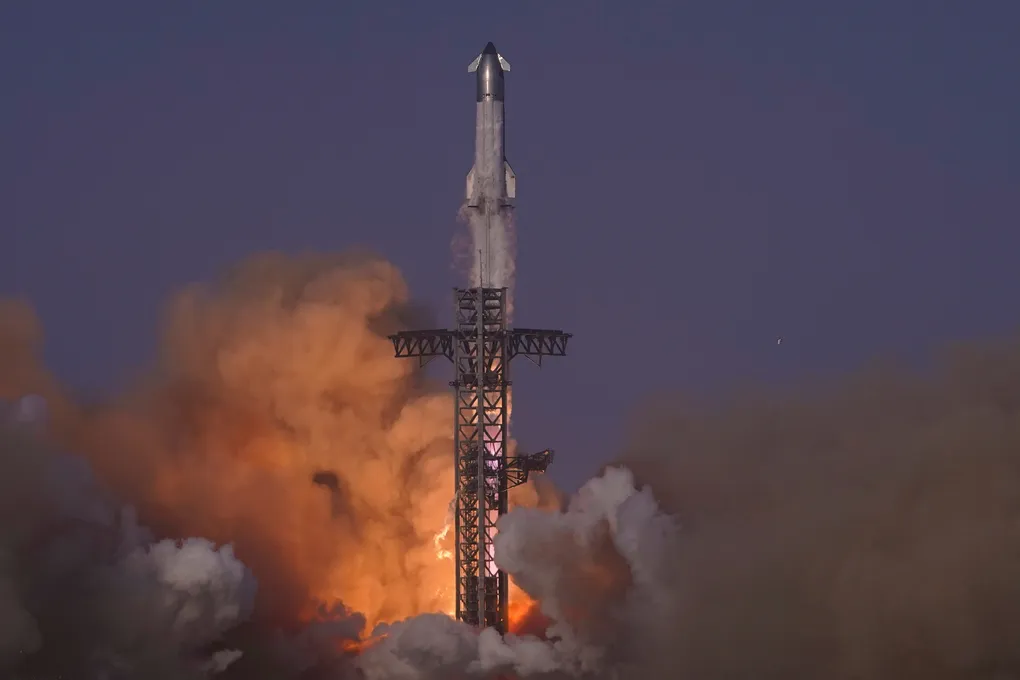
SpaceX launched its massive Starship rocket for the ninth time on Tuesday evening, following two failed attempts earlier this year that ended in mid-flight explosions. The latest test aims to complete a full mission and deploy mock Starlink satellites.
The 403-foot (123-meter) rocket lifted off from Starbase, SpaceX’s private launch site in southern Texas — now newly designated as an official city following a recent vote by residents.
This mission marked the first time a Starship flew with a reused booster, which targeted a splashdown in the Gulf of Mexico. The Starship spacecraft itself was expected to travel halfway around the world and splash down in the Indian Ocean, after releasing eight dummy satellites.
Unlike earlier launches, there were no plans to recover the booster using the “giant chopsticks” system at the launch pad. SpaceX instead focused on testing upgraded thermal tiles and catch fittings designed to aid future land-based recoveries.
The Federal Aviation Administration cleared the test last week, widening the hazard zone and scheduling liftoff outside peak air traffic hours to prevent disruptions. Earlier tests had caused brief airline delays but no injuries.
NASA is closely monitoring Starship’s progress as it prepares for future crewed missions to the Moon. A lunar flyby with four astronauts is planned for next year, with a surface landing expected in 2027 at the earliest — both relying on Starship’s development.
The 403-foot (123-meter) rocket lifted off from Starbase, SpaceX’s private launch site in southern Texas — now newly designated as an official city following a recent vote by residents.
This mission marked the first time a Starship flew with a reused booster, which targeted a splashdown in the Gulf of Mexico. The Starship spacecraft itself was expected to travel halfway around the world and splash down in the Indian Ocean, after releasing eight dummy satellites.
Unlike earlier launches, there were no plans to recover the booster using the “giant chopsticks” system at the launch pad. SpaceX instead focused on testing upgraded thermal tiles and catch fittings designed to aid future land-based recoveries.
The Federal Aviation Administration cleared the test last week, widening the hazard zone and scheduling liftoff outside peak air traffic hours to prevent disruptions. Earlier tests had caused brief airline delays but no injuries.
NASA is closely monitoring Starship’s progress as it prepares for future crewed missions to the Moon. A lunar flyby with four astronauts is planned for next year, with a surface landing expected in 2027 at the earliest — both relying on Starship’s development.