
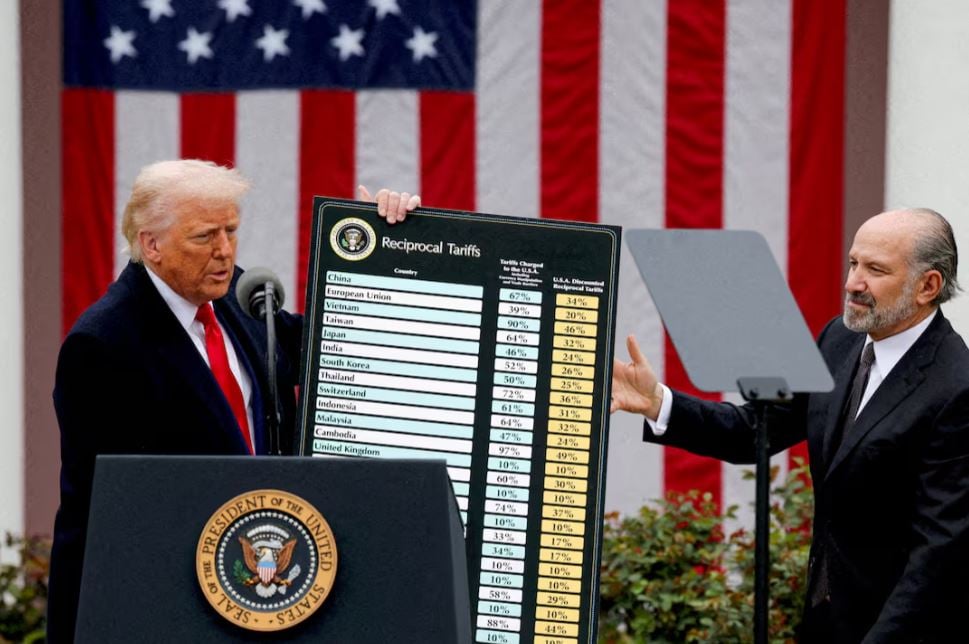
A sweeping wave of new U.S. tariffs announced by President Donald Trump on dozens of trading partners has sent global stock markets plunging and triggered a scramble among governments and companies seeking revised trade terms.
The new tariffs, some of the steepest imposed by the U.S. since the 1930s, range from 10 to 50 percent and apply to 69 countries. They are set to take effect next week, with the average U.S. tariff rate jumping to 18 percent from 2.3 percent a year ago, according to Capital Economics.
Countries, including Switzerland and India, were quick to react. Switzerland, hit with a 39 percent tariff, called for urgent negotiations, while India, facing a 25 percent duty, is also in talks with Washington. Canada was slapped with a 35 percent tariff on some goods — up from 25 percent — particularly in response to what Trump claimed was a lack of cooperation in stopping illicit fentanyl flows.
According to reports, Markets responded sharply. The Dow Jones Industrial Average fell 1.23 percent, the S&P 500 dropped 1.6 percent, and the Nasdaq Composite sank 2.24 percent. In Europe, the STOXX 600 lost 1.89 percent, as uncertainty spread across financial markets.
The sell-off was exacerbated by disappointing U.S. jobs data. July job growth slowed more than expected, and previous figures were revised down. In response, Trump dismissed Erika McEntarfer, Commissioner of the Bureau of Labor Statistics, claiming without evidence that the figures were manipulated.
Trump’s administration defended the tariffs as a negotiating tool. Council of Economic Advisers Chair Stephen Miran said the uncertainty helped the U.S. gain leverage in recent trade deals. However, the president’s moves have also generated confusion, with countries unsure how new rules — including transshipment restrictions — will be enforced.
Amid rising import duties, the U.S. Commerce Department reported price increases, with home furnishings and durable goods jumping 1.3 percent in June — the largest rise since March 2022.
Some Southeast Asian countries welcomed more moderate tariffs, with Thailand noting a cut from 36 to 19 percent as a boost for competitiveness. Australia retained a lower 10 percent rate, prompting optimism from officials there.
Still, analysts warned of broader negative impacts. “No real winners in trade conflicts,” said Thomas Rupf of VP Bank in Singapore. German winemaker Johannes Selbach echoed the concern, saying jobs and profits would be affected on both sides of the Atlantic.
Companies like L’Oreal are exploring ways to reduce their tariff burden using older customs rules such as the “First Sale” clause, which allows duties to be calculated based on factory prices rather than final retail value.
As tensions rise, countries such as India and Canada are seeking revised trade terms. India is working to protect \$40 billion in exports affected by the new tariffs, while Canadian Prime Minister Mark Carney called Trump’s actions “disappointing” and pledged to defend Canadian jobs.
Despite the global pushback, Trump’s administration remains firm, stating that some partners have failed to offer fair terms or align with U.S. economic and security priorities. As the tariffs take effect, the global economy braces for further disruption.
The new tariffs, some of the steepest imposed by the U.S. since the 1930s, range from 10 to 50 percent and apply to 69 countries. They are set to take effect next week, with the average U.S. tariff rate jumping to 18 percent from 2.3 percent a year ago, according to Capital Economics.
Countries, including Switzerland and India, were quick to react. Switzerland, hit with a 39 percent tariff, called for urgent negotiations, while India, facing a 25 percent duty, is also in talks with Washington. Canada was slapped with a 35 percent tariff on some goods — up from 25 percent — particularly in response to what Trump claimed was a lack of cooperation in stopping illicit fentanyl flows.
According to reports, Markets responded sharply. The Dow Jones Industrial Average fell 1.23 percent, the S&P 500 dropped 1.6 percent, and the Nasdaq Composite sank 2.24 percent. In Europe, the STOXX 600 lost 1.89 percent, as uncertainty spread across financial markets.
The sell-off was exacerbated by disappointing U.S. jobs data. July job growth slowed more than expected, and previous figures were revised down. In response, Trump dismissed Erika McEntarfer, Commissioner of the Bureau of Labor Statistics, claiming without evidence that the figures were manipulated.
Trump’s administration defended the tariffs as a negotiating tool. Council of Economic Advisers Chair Stephen Miran said the uncertainty helped the U.S. gain leverage in recent trade deals. However, the president’s moves have also generated confusion, with countries unsure how new rules — including transshipment restrictions — will be enforced.
Amid rising import duties, the U.S. Commerce Department reported price increases, with home furnishings and durable goods jumping 1.3 percent in June — the largest rise since March 2022.
Some Southeast Asian countries welcomed more moderate tariffs, with Thailand noting a cut from 36 to 19 percent as a boost for competitiveness. Australia retained a lower 10 percent rate, prompting optimism from officials there.
Still, analysts warned of broader negative impacts. “No real winners in trade conflicts,” said Thomas Rupf of VP Bank in Singapore. German winemaker Johannes Selbach echoed the concern, saying jobs and profits would be affected on both sides of the Atlantic.
Companies like L’Oreal are exploring ways to reduce their tariff burden using older customs rules such as the “First Sale” clause, which allows duties to be calculated based on factory prices rather than final retail value.
As tensions rise, countries such as India and Canada are seeking revised trade terms. India is working to protect \$40 billion in exports affected by the new tariffs, while Canadian Prime Minister Mark Carney called Trump’s actions “disappointing” and pledged to defend Canadian jobs.
Despite the global pushback, Trump’s administration remains firm, stating that some partners have failed to offer fair terms or align with U.S. economic and security priorities. As the tariffs take effect, the global economy braces for further disruption.