
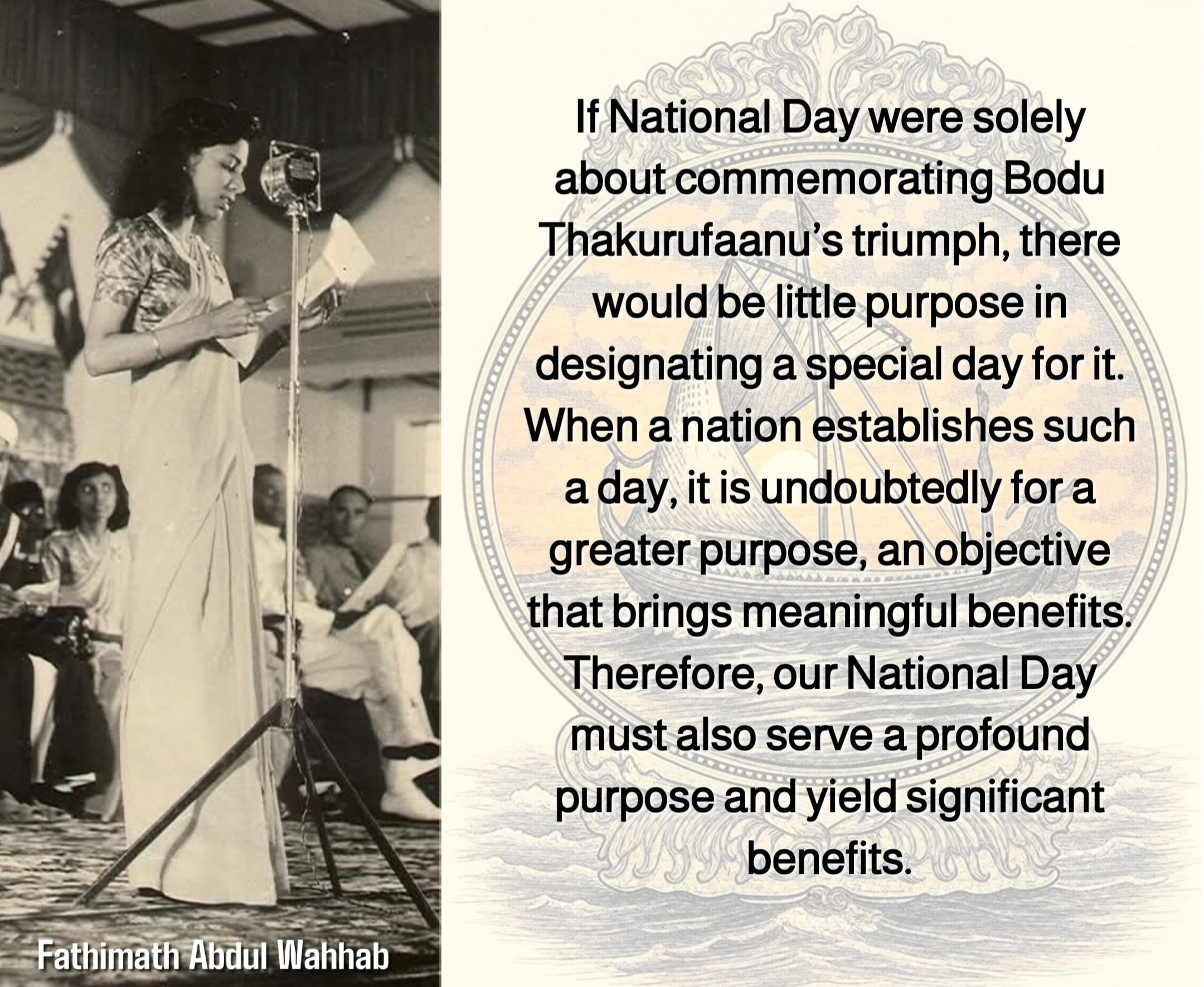
The reason and purpose for designating a specific day as National Day and celebrating it have been greatly misunderstood. Undoubtedly, the day chosen for this celebration is when the national hero Al-Ghazi Muhammad Bodu Thakurufaanu liberated the Maldives from Portuguese colonial rule and re-established Maldivian self-governance. However, the purpose of celebrating this day extends far beyond merely commemorating Bodu Thakurufaanu’s jihad. It is a day to honour all the heroes who have contributed to the Maldives’ progress as a nation, to express heartfelt gratitude for their sacrifices, and to foster national pride while reviving and nurturing the spirit of patriotism.
The following is an excerpt from an article written by Fathimath Abdul Wahhab, published in the government newspaper on the occasion of the first National Day celebrated in the Maldives on 1 Rabi’ al-Awwal 1365, corresponding to February 3, 1946, in the Gregorian calendar. Her writing eloquently clarifies the reason and purpose behind establishing National Day:
“Every civilized nation in the world observes a special National Day, a day dedicated to expressing praise, gratitude, and celebration for the blessings bestowed upon the nation. It is a day to lay a strong foundation for reviving the noble spirit of patriotism in the hearts of its people and fostering national unity. It is a time to renew the memories of the great individuals who have shaped the nation, acknowledging their noble contributions to its progress. It is a day to reflect deeply on their steadfast lives and to inspire personal transformation in their likeness. It is also an occasion to set lofty aspirations for the nation’s future.
Until recently, the Maldives did not have a National Day. However, our small nation has now established this significant tradition. This day, as all Maldivians should know, is the 1st of Rabi’ al-Awwal, the day when Al-Ghazi Muhammad Thakurufaanu, also known as Bodu Thakurufaanu, saved the Maldives. But does National Day only signify the day Bodu Thakurufaanu liberated our nation? His victory is, indeed, a central part of this celebration, but its significance extends beyond this single event, encompassing multiple perspectives and meanings.
If National Day were solely about commemorating Bodu Thakurufaanu’s triumph, there would be little purpose in designating a special day for it. When a nation establishes such a day, it is undoubtedly for a greater purpose, an objective that brings meaningful benefits. Therefore, our National Day must also serve a profound purpose and yield significant benefits.
Yes! The purpose of creating a National Day is to renew the national spirit in our hearts. It is a moment to reflect on whether we, as Maldivians, are adorned with the noble spirit of patriotism. It is a time to assess whether our small nation is bound by the strong pillars of a resilient national spirit and unity.
In my view, and with certainty, the primary duty of National Day is to offer praise and gratitude to Allah Almighty, who has preserved our Maldivian nation in the noble Islamic faith and blessed us with independence to this day. It is also a time to express praise and congratulations to the noble Maldivians who bequeathed these two great blessings to us.
‘Do not be indifferent to the blessings received,
Express gratitude with a sincere heart.
For the independence bestowed upon this land,
Rejoice with a joyful spirit.’
Yes! Praise and gratitude to Allah Almighty. Praise and congratulations to our noble ancestors. Sincere thanks!”
Fathimath Abdul Wahhab’s words, written on the historic occasion of the Maldives’ first National Day in 1946, underscore that this day is not only a commemoration of a single hero’s victory but a celebration of the collective efforts of all who have shaped the nation, a reaffirmation of gratitude to Allah, and a call to nurture unity and patriotism for the future.
The following is an excerpt from an article written by Fathimath Abdul Wahhab, published in the government newspaper on the occasion of the first National Day celebrated in the Maldives on 1 Rabi’ al-Awwal 1365, corresponding to February 3, 1946, in the Gregorian calendar. Her writing eloquently clarifies the reason and purpose behind establishing National Day:
“Every civilized nation in the world observes a special National Day, a day dedicated to expressing praise, gratitude, and celebration for the blessings bestowed upon the nation. It is a day to lay a strong foundation for reviving the noble spirit of patriotism in the hearts of its people and fostering national unity. It is a time to renew the memories of the great individuals who have shaped the nation, acknowledging their noble contributions to its progress. It is a day to reflect deeply on their steadfast lives and to inspire personal transformation in their likeness. It is also an occasion to set lofty aspirations for the nation’s future.
Until recently, the Maldives did not have a National Day. However, our small nation has now established this significant tradition. This day, as all Maldivians should know, is the 1st of Rabi’ al-Awwal, the day when Al-Ghazi Muhammad Thakurufaanu, also known as Bodu Thakurufaanu, saved the Maldives. But does National Day only signify the day Bodu Thakurufaanu liberated our nation? His victory is, indeed, a central part of this celebration, but its significance extends beyond this single event, encompassing multiple perspectives and meanings.
If National Day were solely about commemorating Bodu Thakurufaanu’s triumph, there would be little purpose in designating a special day for it. When a nation establishes such a day, it is undoubtedly for a greater purpose, an objective that brings meaningful benefits. Therefore, our National Day must also serve a profound purpose and yield significant benefits.
Yes! The purpose of creating a National Day is to renew the national spirit in our hearts. It is a moment to reflect on whether we, as Maldivians, are adorned with the noble spirit of patriotism. It is a time to assess whether our small nation is bound by the strong pillars of a resilient national spirit and unity.
In my view, and with certainty, the primary duty of National Day is to offer praise and gratitude to Allah Almighty, who has preserved our Maldivian nation in the noble Islamic faith and blessed us with independence to this day. It is also a time to express praise and congratulations to the noble Maldivians who bequeathed these two great blessings to us.
‘Do not be indifferent to the blessings received,
Express gratitude with a sincere heart.
For the independence bestowed upon this land,
Rejoice with a joyful spirit.’
Yes! Praise and gratitude to Allah Almighty. Praise and congratulations to our noble ancestors. Sincere thanks!”
Fathimath Abdul Wahhab’s words, written on the historic occasion of the Maldives’ first National Day in 1946, underscore that this day is not only a commemoration of a single hero’s victory but a celebration of the collective efforts of all who have shaped the nation, a reaffirmation of gratitude to Allah, and a call to nurture unity and patriotism for the future.