
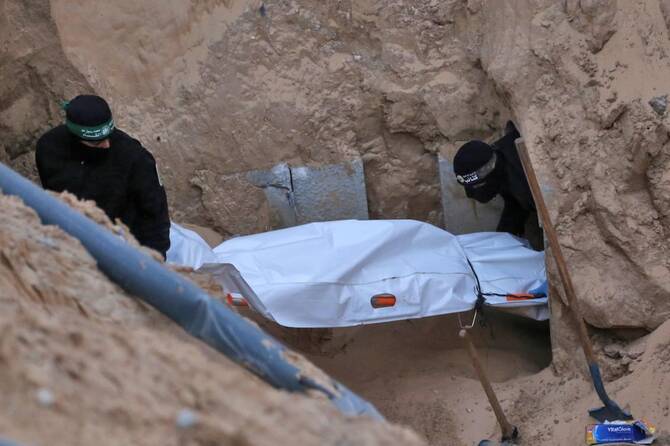
Israel announced on Saturday that three bodies it received from Gaza the previous night were not among the hostages held in the Palestinian territory, as reports emerged of renewed Israeli strikes in southern Gaza.
According to Israel’s military, forensic tests confirmed that the bodies handed over via the Red Cross were not those of deceased captives still to be returned under the ongoing ceasefire agreement. The truce, brokered by the United States and in place since October 10, aims to facilitate the release of all Israeli hostages, both living and dead.
Hamas’s armed wing, the Ezzedine Al-Qassam Brigades, said it had transferred the bodies without identification to “preempt any enemy claims,” after Israel allegedly rejected an offer to receive samples for testing.
Since the start of the ceasefire, Hamas has returned 20 surviving hostages and the remains of several others. Of the 17 bodies returned, 15 were Israeli, one Thai, and one Nepalese. The group has also provided partial remains of another Israeli hostage, sparking outrage in Israel for allegedly violating the agreement.
Tensions remain high as both sides accuse each other of breaching the fragile truce. A Hamas security source said Israeli warplanes and warships carried out strikes near Khan Yunis early Saturday, while earlier in the week, more than 100 Palestinians were reportedly killed in Israeli attacks following the death of an Israeli soldier.
Meanwhile, discussions over the later stages of the ceasefire plan—proposed by U.S. President Donald Trump—are ongoing. The plan calls for the disarmament of Hamas, the formation of a transitional authority, and the deployment of an international stabilization force supported by Egypt and Jordan.
Jordanian Foreign Minister Ayman Safadi and his German counterpart Johann Wadephul emphasized in Bahrain that such a force must operate under a UN Security Council mandate to be effective.
In Gaza, many residents displaced by months of fighting continue to live in tents amid widespread devastation. “The truce has begun, but the war hasn’t ended,” said Hisham Al-Bardai, a father of five from Jabalia camp. “There’s no hope for life to return, even partially.”
According to Israel’s military, forensic tests confirmed that the bodies handed over via the Red Cross were not those of deceased captives still to be returned under the ongoing ceasefire agreement. The truce, brokered by the United States and in place since October 10, aims to facilitate the release of all Israeli hostages, both living and dead.
Hamas’s armed wing, the Ezzedine Al-Qassam Brigades, said it had transferred the bodies without identification to “preempt any enemy claims,” after Israel allegedly rejected an offer to receive samples for testing.
Since the start of the ceasefire, Hamas has returned 20 surviving hostages and the remains of several others. Of the 17 bodies returned, 15 were Israeli, one Thai, and one Nepalese. The group has also provided partial remains of another Israeli hostage, sparking outrage in Israel for allegedly violating the agreement.
Tensions remain high as both sides accuse each other of breaching the fragile truce. A Hamas security source said Israeli warplanes and warships carried out strikes near Khan Yunis early Saturday, while earlier in the week, more than 100 Palestinians were reportedly killed in Israeli attacks following the death of an Israeli soldier.
Meanwhile, discussions over the later stages of the ceasefire plan—proposed by U.S. President Donald Trump—are ongoing. The plan calls for the disarmament of Hamas, the formation of a transitional authority, and the deployment of an international stabilization force supported by Egypt and Jordan.
Jordanian Foreign Minister Ayman Safadi and his German counterpart Johann Wadephul emphasized in Bahrain that such a force must operate under a UN Security Council mandate to be effective.
In Gaza, many residents displaced by months of fighting continue to live in tents amid widespread devastation. “The truce has begun, but the war hasn’t ended,” said Hisham Al-Bardai, a father of five from Jabalia camp. “There’s no hope for life to return, even partially.”