
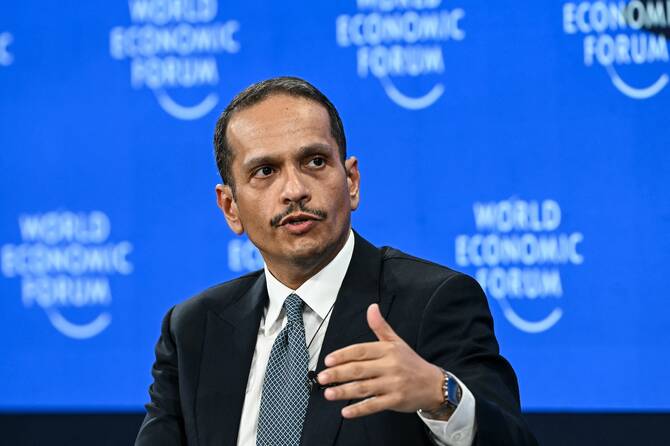
Qatar’s Prime Minister and Foreign Minister Sheikh Mohammed bin Abdulrahman bin Jassim Al-Thani has called for unrestricted humanitarian access to Gaza, warning that aid restrictions continue to hinder relief efforts despite some improvement in conditions.
Speaking at the World Economic Forum in Davos on Tuesday, Sheikh Mohammed said large amounts of humanitarian aid are still unable to enter Gaza and stressed the need for urgent global action to support Palestinians. He said Qatar is working closely with the United States, Egypt, and Turkiye to support the newly established technocratic Palestinian government in Gaza and improve living conditions for civilians.
His remarks came amid the launch of the second phase of a US-backed plan to end the war in Gaza, which includes the formation of a 15-member technocratic Palestinian administration.
Sheikh Mohammed also highlighted the ongoing humanitarian crisis, echoing warnings from the United Nations that restrictions on aid agencies and supplies are preventing meaningful recovery in Gaza.
Turning to Syria, the Qatari prime minister called on the international community to support the rebuilding of Syrian state institutions following years of conflict, stressing the need for an inclusive system that protects the rights of all Syrians.
He also noted Qatar’s strategic role in global energy supply, saying the country is well positioned to support growing energy demands driven by advances in artificial intelligence and technology.
Speaking at the World Economic Forum in Davos on Tuesday, Sheikh Mohammed said large amounts of humanitarian aid are still unable to enter Gaza and stressed the need for urgent global action to support Palestinians. He said Qatar is working closely with the United States, Egypt, and Turkiye to support the newly established technocratic Palestinian government in Gaza and improve living conditions for civilians.
His remarks came amid the launch of the second phase of a US-backed plan to end the war in Gaza, which includes the formation of a 15-member technocratic Palestinian administration.
Sheikh Mohammed also highlighted the ongoing humanitarian crisis, echoing warnings from the United Nations that restrictions on aid agencies and supplies are preventing meaningful recovery in Gaza.
Turning to Syria, the Qatari prime minister called on the international community to support the rebuilding of Syrian state institutions following years of conflict, stressing the need for an inclusive system that protects the rights of all Syrians.
He also noted Qatar’s strategic role in global energy supply, saying the country is well positioned to support growing energy demands driven by advances in artificial intelligence and technology.