
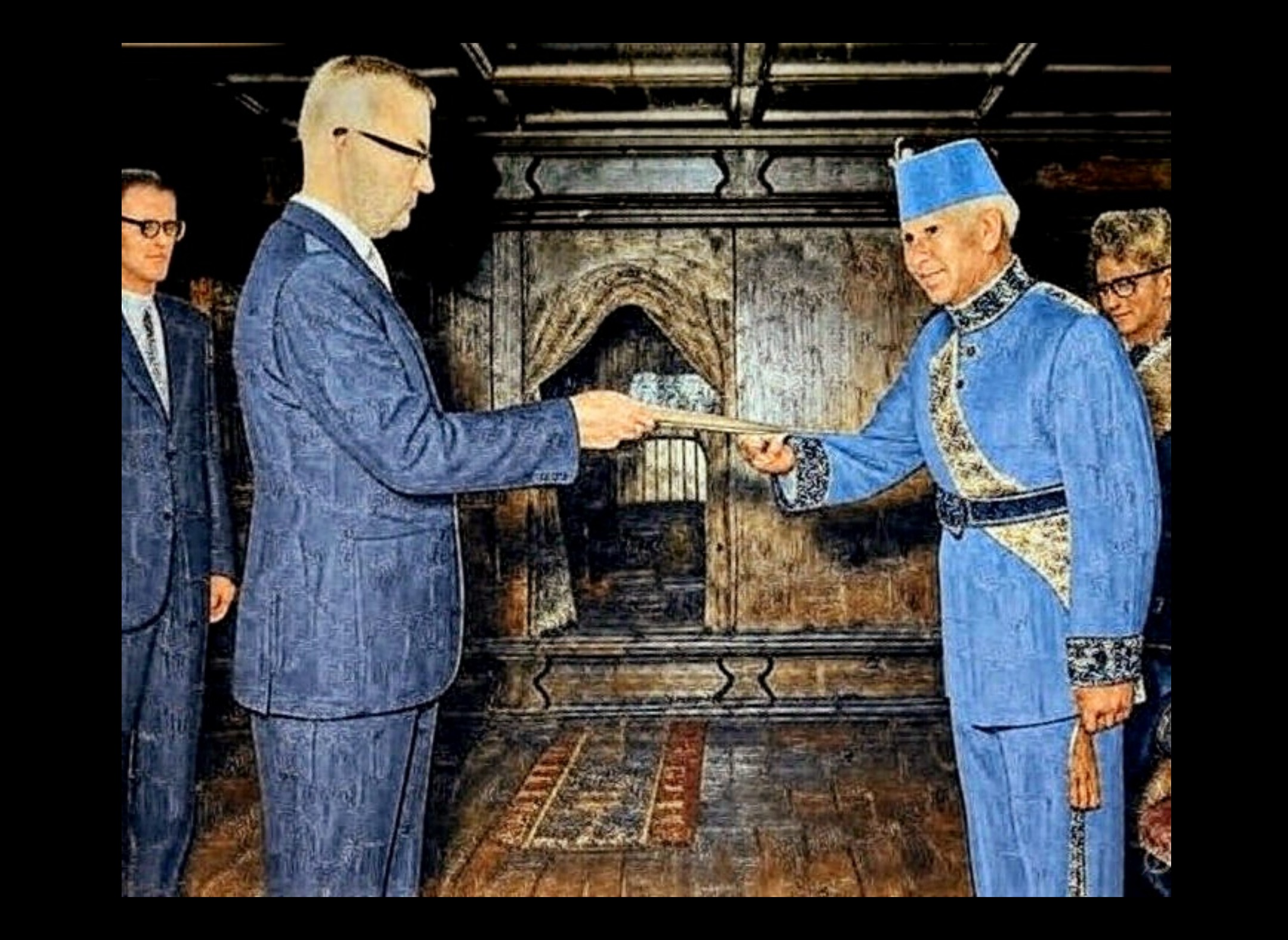
On December 12, 1967, in the serene island nation of the Maldives, a moment of royal candor and diplomatic finesse unfolded in the court of His Majesty Sultan Mohamed Fareed, the last king of the Maldives. This story, shared by Mohamed Muizz Adnan on Facebook, was originally recounted by his father, Adnan Hussain of Gulfaamge, who served as His Majesty’s Private Secretary (Katib al-Sirr) during a significant meeting with Andrew Vincent Corry, the American Ambassador to the Maldives.
The occasion was steeped in formality: Ambassador Corry had arrived to present his credentials, a ceremonial act marking the official start of his diplomatic mission. As per Maldivian protocol, such meetings followed a structured rhythm. His Majesty spoke in Dhivehi, the native language, with Adnan providing translations for the foreign guest until refreshments were served, at which point the King, fluent in English, might opt to converse directly. The setting was one of tradition, where every word and gesture carried the weight of diplomacy.
As the conversation unfolded, Ambassador Corry, perhaps aiming to inject a note of intrigue, shared a peculiar remark. He noted that a renowned Jewish astrologer in America had predicted the world’s end in the coming year. The comment, likely intended as a lighthearted aside, hung in the air of the royal court. His Majesty Sultan Mohamed Fareed, known for his directness and no-nonsense demeanor, listened as Adnan prepared to translate. Without missing a beat, His Majesty responded in Dhivehi with a blend of conviction and disdain: “Such matters are celestial affairs. Mortals cannot know them. Do not tell me such foolish stories that Jews spread to mislead people.”
Adnan, tasked with the delicate role of translator, paused for a fleeting moment, grappling with how to convey His Majesty’s blunt words in a way that preserved diplomatic courtesy. Sensing his secretary’s hesitation, His Majesty fixed him with a knowing look and declared, “You are fearing to say it, aren’t you? I will say it.” Steadfast in his duty, Adnan relayed His Majesty’s exact sentiment to the Ambassador, capturing its unfiltered essence with precision.
The Ambassador, caught off guard by the King’s forthright rebuke, responded with a respectful, “I’m sorry, Your Majesty,” before swiftly pivoting to a new topic, diffusing the tension with diplomatic grace. This brief yet vivid exchange encapsulated His Majesty Sultan Mohamed Fareed’s sharp intellect and his dismissal of what he viewed as fanciful predictions, while highlighting Adnan’s careful navigation of a moment where cultural and diplomatic sensitivities intersected.
Preserved through Adnan’s storytelling and shared by his son, this anecdote from December 12, 1967, offers a rare glimpse into the Maldives’ final years of monarchy. It paints a picture of a confident ruler unafraid to speak his mind and a loyal secretary balancing fidelity to His Majesty with the nuances of international diplomacy. In this fleeting moment, the royal court of His Majesty Sultan Mohamed Fareed stood as a stage where tradition, wit, and global encounters converged.
The occasion was steeped in formality: Ambassador Corry had arrived to present his credentials, a ceremonial act marking the official start of his diplomatic mission. As per Maldivian protocol, such meetings followed a structured rhythm. His Majesty spoke in Dhivehi, the native language, with Adnan providing translations for the foreign guest until refreshments were served, at which point the King, fluent in English, might opt to converse directly. The setting was one of tradition, where every word and gesture carried the weight of diplomacy.
As the conversation unfolded, Ambassador Corry, perhaps aiming to inject a note of intrigue, shared a peculiar remark. He noted that a renowned Jewish astrologer in America had predicted the world’s end in the coming year. The comment, likely intended as a lighthearted aside, hung in the air of the royal court. His Majesty Sultan Mohamed Fareed, known for his directness and no-nonsense demeanor, listened as Adnan prepared to translate. Without missing a beat, His Majesty responded in Dhivehi with a blend of conviction and disdain: “Such matters are celestial affairs. Mortals cannot know them. Do not tell me such foolish stories that Jews spread to mislead people.”
Adnan, tasked with the delicate role of translator, paused for a fleeting moment, grappling with how to convey His Majesty’s blunt words in a way that preserved diplomatic courtesy. Sensing his secretary’s hesitation, His Majesty fixed him with a knowing look and declared, “You are fearing to say it, aren’t you? I will say it.” Steadfast in his duty, Adnan relayed His Majesty’s exact sentiment to the Ambassador, capturing its unfiltered essence with precision.
The Ambassador, caught off guard by the King’s forthright rebuke, responded with a respectful, “I’m sorry, Your Majesty,” before swiftly pivoting to a new topic, diffusing the tension with diplomatic grace. This brief yet vivid exchange encapsulated His Majesty Sultan Mohamed Fareed’s sharp intellect and his dismissal of what he viewed as fanciful predictions, while highlighting Adnan’s careful navigation of a moment where cultural and diplomatic sensitivities intersected.
Preserved through Adnan’s storytelling and shared by his son, this anecdote from December 12, 1967, offers a rare glimpse into the Maldives’ final years of monarchy. It paints a picture of a confident ruler unafraid to speak his mind and a loyal secretary balancing fidelity to His Majesty with the nuances of international diplomacy. In this fleeting moment, the royal court of His Majesty Sultan Mohamed Fareed stood as a stage where tradition, wit, and global encounters converged.