
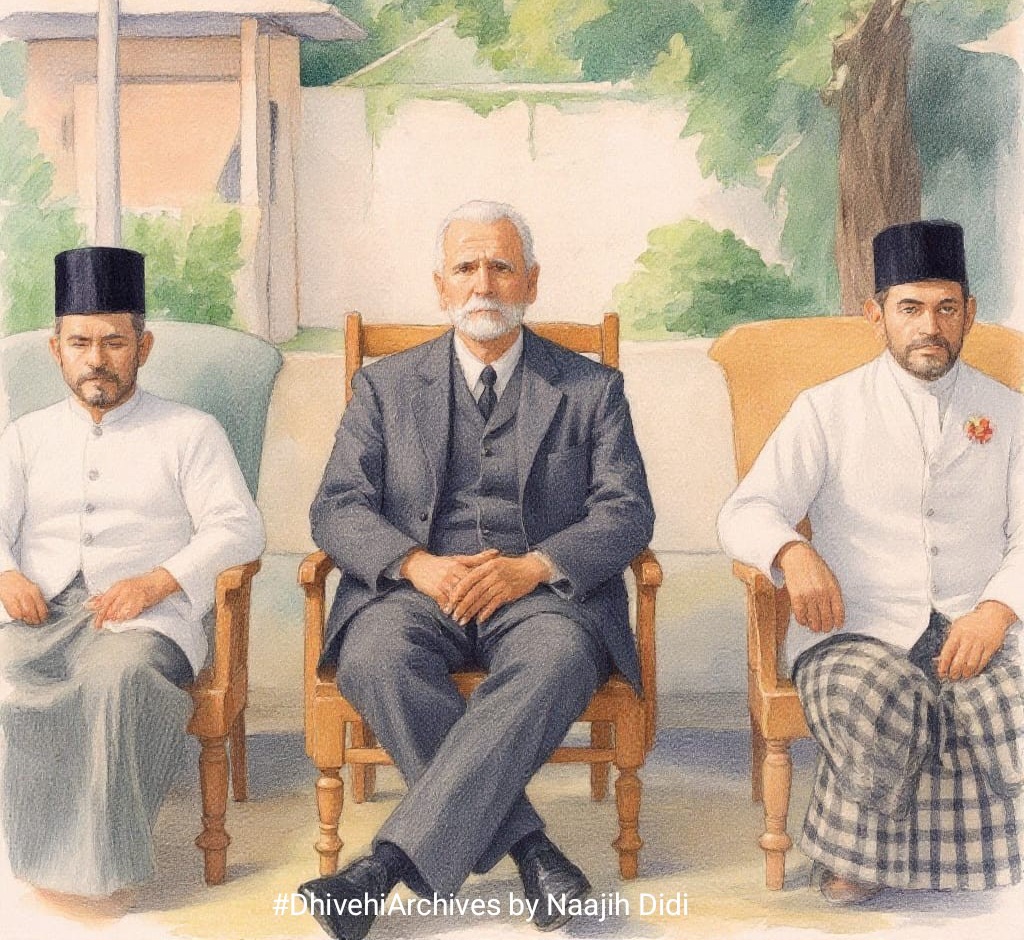
In the turquoise embrace of the Indian Ocean, where coral reefs whisper ancient tales, Harry Charles Purvis Bell—known as HCP Bell—unearthed the Maldives’ buried past. As a Maldivian, I feel a profound connection to this British civil servant from colonial Ceylon (now Sri Lanka), who became a guardian of our islands’ story. Shipwrecked in our atolls in 1879, Bell’s fascination with the Maldives brought him back in 1920 and 1922, determined to preserve the echoes of our Buddhist roots and Islamic heritage before the tides of time swept them away.
Born in 1851, Bell rose to become Ceylon’s first Archaeological Commissioner in 1890, but his heart belonged to the Maldives’ 1,200 islands, strewn with ancient stupas and etched stones. His explorations uncovered pre-Islamic Buddhist sites in places like Hadhdhunmathi and Fuvahmulah, revealing trade routes that once carried Buddhist teachings from Sri Lanka before Islam took root in 1153 CE. His works, The Máldive Islands: An Account (1882) and The Máldive Islands: Monograph on the History, Archaeology, and Epigraphy (1940), are treasures, earning him the title of pioneer in Maldivian historical studies.
Beyond ancient ruins, Bell chronicled the Maldives’ Islamic era, documenting the sultanate’s growth, its trade in cowries and coir, and its governance under Islam. He detailed the constitutional monarchy and the British protectorate established in 1887, navigating the political currents shaped by powerful families. Central to his work was his alliance with the influential Athireege family, a non-royal branch of the Huraage dynasty, particularly Athireege Ibrahim Didi (Ibrahim Dhorhimeynaa Kilegefaanu), a Prime Minister who steered the Maldives toward British protection.
Ibrahim Didi’s rival, Kakaage Mohamed Didi (Muhammad Rannaban’deyri Kilagefaanu), from the royal branch of the Huraage, was another key figure—a former Prime Minister whose Kakaage clan fiercely contested the Athireege for dominance in Malé. In 1903, Ibrahim Didi outmaneuvered the Kakaage, securing Athireege influence until 1953. His grandson, Muhammad Fareed, became the last Sultan, reigning until the monarchy’s end in 1968. Ibrahim Didi’s support was crucial for Bell, granting access to records, oral histories, and restricted sites. With the sultan’s patronage, facilitated by Ibrahim Didi, Bell secured boats, manpower, and permissions to explore Buddhist relics, mosques, and cemeteries, navigating Malé’s turbulent politics with insight.
Bell’s work, though tinged with colonial perspectives, preserved a history at risk of vanishing amid modernization and religious shifts. His meticulous records of the Maldives’ Buddhist-to-Islamic transition and its political intricacies remain invaluable. As rising seas and globalization threaten our heritage, Bell’s monographs guide ongoing excavations and preservation efforts. Like the coral atolls, his legacy—layered, fragile, and enduring—ensures the Maldives’ story remains alive for generations.
Born in 1851, Bell rose to become Ceylon’s first Archaeological Commissioner in 1890, but his heart belonged to the Maldives’ 1,200 islands, strewn with ancient stupas and etched stones. His explorations uncovered pre-Islamic Buddhist sites in places like Hadhdhunmathi and Fuvahmulah, revealing trade routes that once carried Buddhist teachings from Sri Lanka before Islam took root in 1153 CE. His works, The Máldive Islands: An Account (1882) and The Máldive Islands: Monograph on the History, Archaeology, and Epigraphy (1940), are treasures, earning him the title of pioneer in Maldivian historical studies.
Beyond ancient ruins, Bell chronicled the Maldives’ Islamic era, documenting the sultanate’s growth, its trade in cowries and coir, and its governance under Islam. He detailed the constitutional monarchy and the British protectorate established in 1887, navigating the political currents shaped by powerful families. Central to his work was his alliance with the influential Athireege family, a non-royal branch of the Huraage dynasty, particularly Athireege Ibrahim Didi (Ibrahim Dhorhimeynaa Kilegefaanu), a Prime Minister who steered the Maldives toward British protection.
Ibrahim Didi’s rival, Kakaage Mohamed Didi (Muhammad Rannaban’deyri Kilagefaanu), from the royal branch of the Huraage, was another key figure—a former Prime Minister whose Kakaage clan fiercely contested the Athireege for dominance in Malé. In 1903, Ibrahim Didi outmaneuvered the Kakaage, securing Athireege influence until 1953. His grandson, Muhammad Fareed, became the last Sultan, reigning until the monarchy’s end in 1968. Ibrahim Didi’s support was crucial for Bell, granting access to records, oral histories, and restricted sites. With the sultan’s patronage, facilitated by Ibrahim Didi, Bell secured boats, manpower, and permissions to explore Buddhist relics, mosques, and cemeteries, navigating Malé’s turbulent politics with insight.
Bell’s work, though tinged with colonial perspectives, preserved a history at risk of vanishing amid modernization and religious shifts. His meticulous records of the Maldives’ Buddhist-to-Islamic transition and its political intricacies remain invaluable. As rising seas and globalization threaten our heritage, Bell’s monographs guide ongoing excavations and preservation efforts. Like the coral atolls, his legacy—layered, fragile, and enduring—ensures the Maldives’ story remains alive for generations.